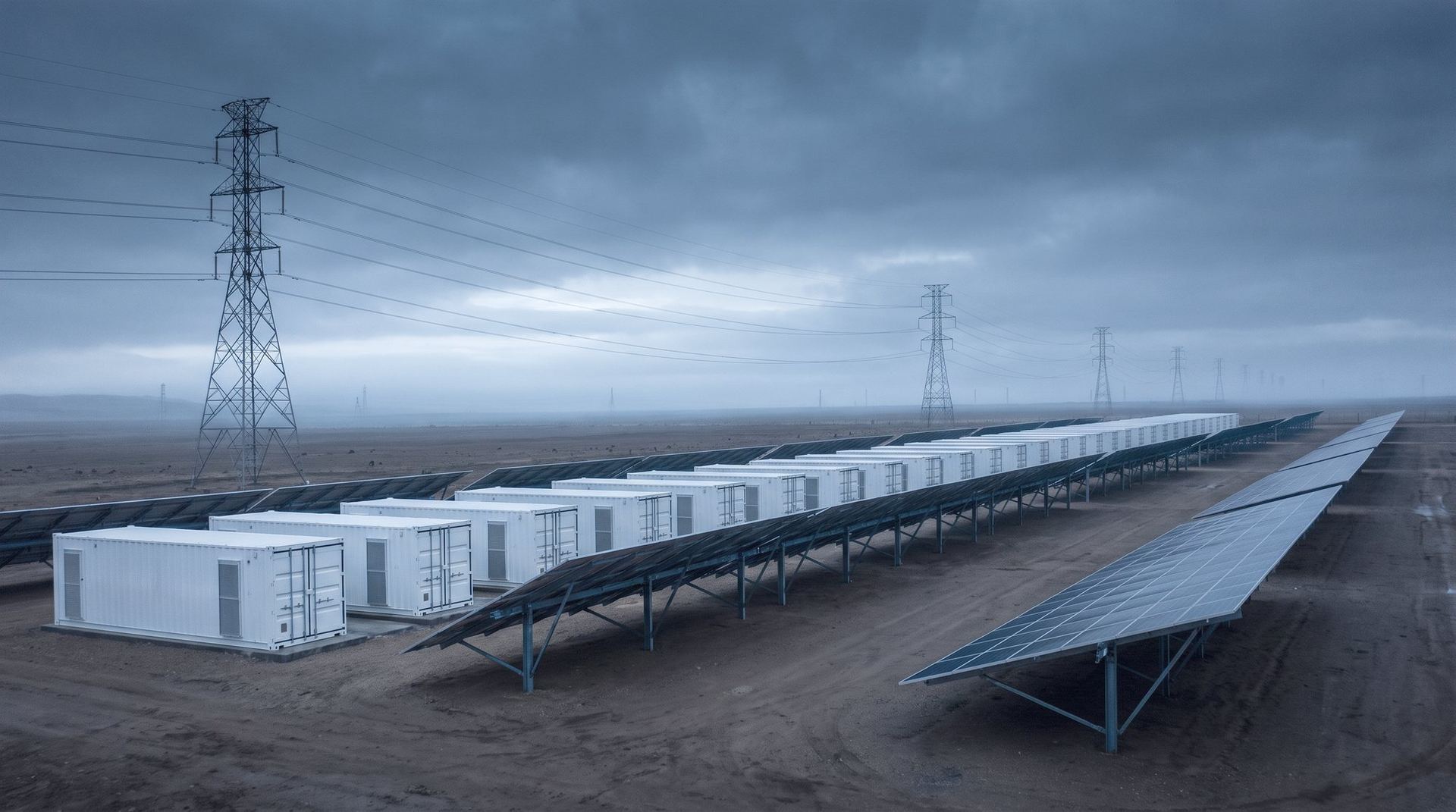
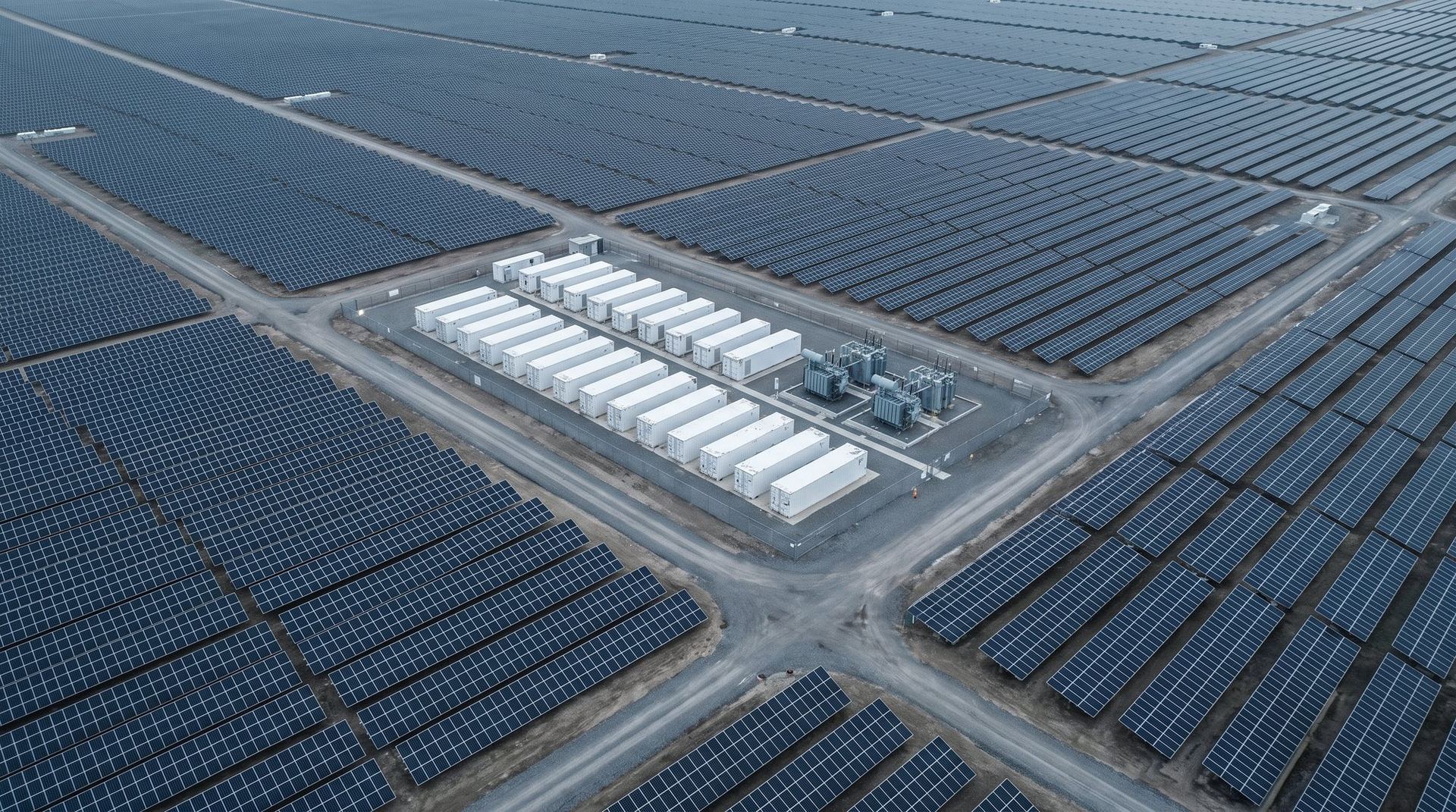
BESS container. Five megawatt-hours in a twenty-foot box.
A liquid-cooled LFP battery energy storage container, integrated, charged, discharged and signed off in the factory in Indore. Available in scalable 1–5 MWh configurations for utility-scale and industrial storage.
What the BESS container is.
Liquid-cooled LFP battery strings, a three-level battery management system, gas detection and pack-level suppression, and the DC distribution to connect to the PCS of your choice — in one container that ships integrated and tested.
What is BESS?
A battery energy storage system stores electrical energy for later use. It captures energy when it is readily available, such as during peak renewable generation, and delivers it when demand increases or energy is needed most. A typical BESS includes battery modules, power conversion systems (inverters) and intelligent control systems that manage charging, discharging and overall performance.
Why is BESS needed?
Solar and wind generate power only when sunlight or wind is available, which leaves a gap between generation and demand. Storage bridges that gap by holding excess energy from peak generation and delivering it when it is needed — making renewable power more reliable and dispatchable, improving its utilisation, supporting grid stability and reducing energy wastage.
Key advantages
Specifications.
The BESS container, its battery packs and the cells inside them. The datasheet for your configuration accompanies each quotation.
| General | Value |
|---|---|
| Battery module configuration | 1P104S |
| Number of battery modules | 48 |
| Number of strings | 12 |
| Number of racks | 6 |
| Configuration | 12P416S |
| BMS communication | Ethernet TCP/IP · CAN · RS485 |
| Gravimetric energy density | 112.7 Wh/kg |
| Volumetric energy density | 117.25 Wh/L |
| Application altitude | < 3,000 m |
| Electrical | Value |
|---|---|
| Nominal energy at DC terminals | 5,015 kWh |
| Nominal DC voltage | 1,331 V |
| Operating DC voltage range | 1,040 – 1,500 V |
| Nominal charge / discharge rate | 0.5P / 0.5P |
| Nominal round-trip efficiency | > 93.7% at 0.5C · > 95.2% at 0.25C |
| Cycle life | > 10,000 |
| Nominal SOC at delivery | 40% |
| Mechanical & environmental | Value |
|---|---|
| Dimensions (W × D × H) | 6,058 × 2,438 × 2,896 mm (238.5 × 96.0 × 114.0 in) |
| Weight | 44,500 kg |
| IP rating | IP55 |
| Anti-corrosion level (ISO 12944) | C5 |
| Cooling method | Liquid |
| Operating ambient temperature | −30 °C to 55 °C |
| Storage ambient temperature | 0 °C to 35 °C; −40 °C to 55 °C short term, up to one month |
| Battery pack | Value |
|---|---|
| Cell type | LFP |
| Cell capacity | 314 – 628 Ah |
| Battery configuration | 1P104S |
| Nominal energy | 104.5 kWh |
| Nominal / operating voltage | 332.8 V / 260 – 379.6 V |
| Cooling method | Liquid cooling, glycol–water coolant system |
| Temperature range (charge / discharge) | 0 °C to 50 °C / −20 °C to 50 °C |
| Application altitude | < 3,000 m |
| Nominal SOC at delivery | 40% |
| Battery cell | Value |
|---|---|
| Cell chemistry | LFP |
| Cell capacity | 314 – 628 Ah |
| Cell voltage | 3.2 V |
| Energy (314 Ah cell) | 1,004.8 Wh |
| Cell weight | 5.5 kg |
| Width · thickness | 174.26 mm · 71.5 mm |
| Total height · body height | 206.5 mm · 204.5 mm |
| Tab distance | 128 mm |
| Internal resistance | 0.18 ± 0.05 mΩ (30% SOC, 1 kHz) |
| Gravimetric energy density | > 178 Wh/kg |
| Volumetric energy density | 389.0 Wh/L |
| Cycle life | 10,000 (to 70% SOH) |
| Storage loss (28 days at 25 °C, 50% SOC) | ≤ 3% per month |
| Standard / maximum charge and discharge | 0.5C / 0.5C · 1C / 1C |
| Charging / discharging temperature | 0 °C to 60 °C / −20 °C to 60 °C |
| Certifications and reports | UL 9540A · UL 1973 · IEC 62619 · UN 38.3 |
Environmental
RoHS and REACH compliant, cobalt-free chemistry, EU Battery Regulation 2023/1542.
Delivered ready to commission
Ships at 40% state of charge after a full charge–discharge factory acceptance test, with the cell supplier's specification and cycle-life curves.
From cell to container.
Every level has its own management, protection and record. What leaves Indore is not a box of cells; it is a documented system.
Module BMS
Measures every cell voltage and eight temperatures per module, balances passively, and reports up the chain every 100 ms.
String BMS
Manages 416 cells in series: current, insulation, contactor and pre-charge control. A fault isolates one string, not the container.
Container BMS and EMS interface
Aggregates the twelve strings, coordinates thermal management and fire safety, and communicates with your EMS or PCS over Ethernet TCP/IP, CAN or RS485. The AI-enabled EMS learns the site's load and tariff pattern to schedule charge and discharge, and watches cell data for early thermal drift.
Augmentation-ready
Designed for a 20-year life with augmentation planning, so capacity can be restored in later years and the plant stays on its contracted profile.
Safety in layers.
Lithium iron phosphate is the most thermally stable chemistry in commercial use. We still design the container as if it were not.
Cobalt-free LFP cells with UL 9540A reports
Lithium iron phosphate cells certified to IEC 62619 and UL 1973, with UL 9540A thermal-runaway propagation reports for the insurer, lender and approving authority.
Liquid cooling with dual pumps
Glycol–water liquid cooling holds cell-to-cell temperature spread below 3 °C, and the system derates in a controlled way if cooling is lost.
Early off-gas detection
Off-gas sensors pick up a developing cell fault before smoke or heat, so the battery management system can act while the event is still confined.
Pack-level aerosol, vents and a dry-pipe interface
Pack-level aerosol suppression, deflagration vents and a dry-pipe connection for the site fire system, in line with NFPA 855. Certified and reported to NFPA 68 and NFPA 69.
Insulation and pre-charge control
Each 416-cell string manages current, insulation monitoring, contactors and pre-charge. A fault isolates one string, not the container.
Where the BESS earns its keep.
India's storage demand is being pulled by tenders that pay for firm, dispatchable renewable power and by industrial buyers who want to stop paying peak tariffs.
FDRE and RTC tenders
Firm and dispatchable renewable energy projects need storage sized to the delivery profile. 2-hour and 4-hour configurations map onto evening-peak delivery obligations.
Solar-plus-storage
Shift the afternoon solar peak into the evening, cut curtailment on constrained feeders, and pair with Kern 132 modules for one warranty conversation.
Standalone and DISCOM storage
Grid-side blocks for peak support, frequency response and deferral of network upgrades under standalone BESS and viability-gap-funded schemes.
C&I peak shaving
Behind-the-meter storage for factories, campuses and data centres to reduce demand charges and use time-of-day tariffs.
Microgrids and remote sites
Replace or reduce diesel at mines, islands and infrastructure sites where fuel logistics dominate the cost of power.
Open-access hybrids
Wind–solar–storage plants selling firm blocks of power under open access, at better tariffs and utilisation.
Size a project.
Enter the energy or power the tender or the load requires and see how many blocks that is, at what C-rate, on how much ground.
Counts 5,015 kWh blocks needed to cover the larger of energy and power × duration, with a 2% usable-energy margin at delivery. Footprint assumes 18 m² per block including service clearance, before PCS, transformers and NFPA 855 separation. Sizing for degradation, auxiliary load and augmentation is done in the engineering proposal.
Certifications and reports.
The standards that Indian and international lenders, insurers and grid operators reference — at container and cell level.
| Certification / report | Scope | Level |
|---|---|---|
| UL 9540 | Energy storage system safety | Container |
| NFPA 68 | Explosion protection by deflagration venting | Container |
| NFPA 69 | Explosion prevention systems | Container |
| NFPA 855 | Installation of stationary energy storage systems | Container |
| IEC 62933-5-1 | Safety of grid-integrated energy storage systems — general | Container |
| IEC 62933-5-2 | Safety of grid-integrated energy storage systems — electrochemical | Container |
| UN 3536 | Transport of lithium batteries installed in cargo transport units | Container |
| UL 9540A | Thermal-runaway fire propagation | Cell |
| UL 1973 | Batteries for stationary applications | Cell |
| IEC 62619 | Safety of industrial lithium cells and batteries | Cell |
| UN 38.3 | Transport of lithium cells and batteries | Cell |
| RoHS · REACH · cobalt-free | Environmental compliance | System |
| EU Battery Regulation 2023/1542 | Battery regulation | System |
Warranty
12+ years warranty, with the capacity warranty tied to a stated cycle and calendar profile. Designed for a 20-year life, augmentation-ready.
Bankability file
Cell supplier qualification data, UL 9540A reports, cycle-life curves, factory acceptance test protocols and results, warranty terms and the group's financial standing, compiled for the lender's technical adviser.
Service and customisation
24/7 service, and customisable OEM and ODM solutions for specific project and integration requirements.
How a project moves with Lumikern.
From the first enquiry to take-back at end of life. Plant visits by appointment for buyers, lenders' engineers and certification bodies.
Enquiry
MW and MWh, location, commissioning date, DCR requirement and PCS preference.
Proposal
Indicative offer, sizing assumptions, delivery schedule and certification status.
Contract
Lot allocation, warranty and long-term service terms, and the factory acceptance test protocol.
Production
Weekly schedule shared with the buyer and a witnessed factory acceptance test for every BESS container.
Delivery
Rail or road dispatch with serial manifests, installation guidance and commissioning support.
Life
Remote monitoring, spares, augmentation planning, and take-back and recycling at end of life.
Send the tender profile. We will send the block count.
Share the required MW, MWh, delivery window and site location and a Lumikern engineer will return a sizing, an indicative offer and a delivery schedule.